
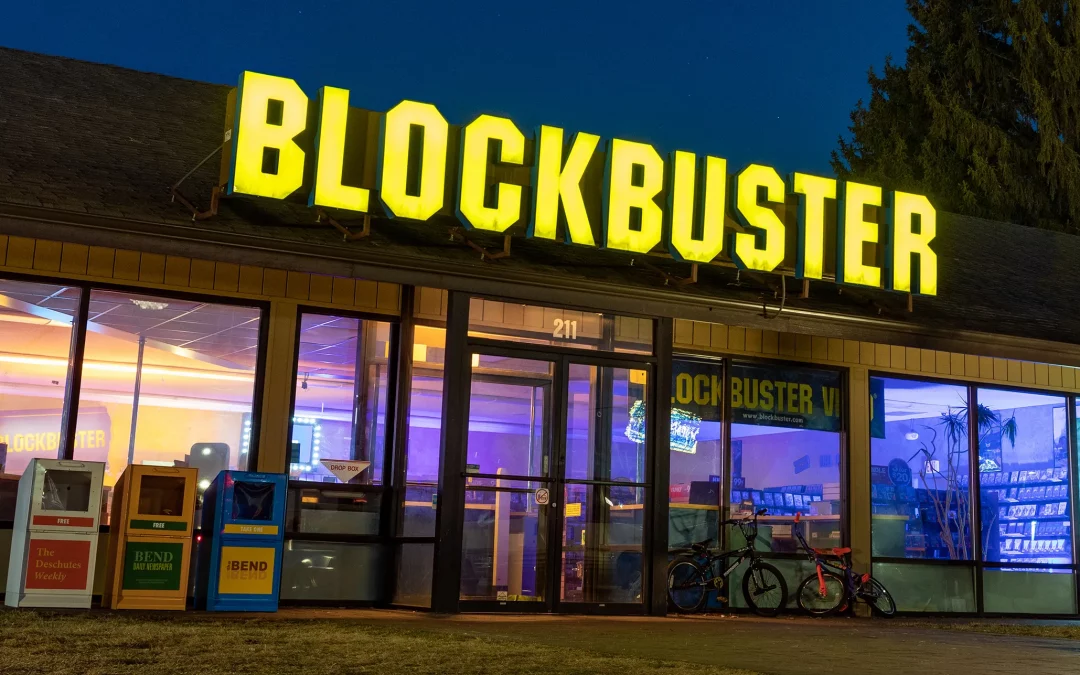
There’s a Blockbuster Video in Bend, Oregon, that still exists. Not as a museum, not as a pop-up art installation, not as an ironic coffee shop, but as an actual, operating video rental store. You can walk in, browse the shelves, pick up a copy of something you half-remember wanting to see, and drive home with a DVD in your hand. It is, almost certainly, the most photographed Blockbuster on earth, not because anyone particularly needs to rent a movie there.
People go because it feels like touching something that shouldn’t still exist.
At its peak in the early 2000s, Blockbuster operated more than 9,000 stores across the United States. There was one in nearly every strip mall in America. Friday nights had a ritual: the drive over, the browsing, the argument over what to watch, and the inevitable late fee you’d swear you’d pay next time. The blue-and-yellow logo was as familiar as a gas station sign. Then Netflix happened. Then streaming. Then, with breathtaking speed, 9,000 stores became one.
Blockbuster’s story is often told as a cautionary tale about corporate stubbornness; the company famously passed on acquiring Netflix for $50 million in 2000. But it’s also something more universal. It’s a story about how the things we build our lives around can quietly become irrelevant before we’ve even noticed we stopped needing them.
The Brands We Thought Would Always Be There
Blockbuster isn’t alone in this. Borders Books, Sears, RadioShack, Toys”R”Us, and Pier 1 weren’t fringe businesses; they were the architecture of American consumer life for decades. Children grew up in their aisles. Families planned trips around them. And then, one by one, they became nostalgic footnotes.
What’s striking isn’t that these brands failed. Businesses fail. What’s striking is how completely they vanished from our daily lives and how little we actually missed them once they were gone. We had already moved on before the lights went out.
The lesson isn’t really about retail. It’s about adaptability and the difference between things that hold lasting value and those that merely feel permanent because we’re used to them.
What This Means for Real Estate
In real estate, we see this dynamic play out in the physical world every day.
Consider what happened to the neighborhoods built around these now-defunct anchors. Strip malls anchored by Sears sat half-empty for years. Shopping centers that relied on a Borders or a Circuit City as their traffic engine suddenly had a gaping void where foot traffic once flowed. The real estate around those businesses was dramatically affected, not because the land lost value but because the use case had evaporated.
This is one of the most important things a buyer or investor can understand about property: location isn’t static. What surrounds a property today shapes its value today, but the neighborhood’s trajectory shapes its value tomorrow.
The savviest real estate decisions we’ve seen over the past two decades have come from clients who looked beyond what a neighborhood is and thought carefully about what it’s becoming. They bought into areas where the fundamentals were strong, such as walkability, infrastructure, schools, and natural amenities, rather than areas propped up by a single retailer or employer that could be disrupted overnight.
Bend, Oregon, incidentally, is a fascinating real estate market. The same city that’s home to the last Blockbuster has also been one of the fastest-growing real estate markets in the Pacific Northwest, driven by remote work migration, outdoor recreation culture, and a quality of life that doesn’t depend on any single brand or industry. The Blockbuster there survives partly because the community around it is thriving, full of people with the economic security and whimsy to rent a DVD for the experience of it.
Enduring Value vs. Borrowed Value
At LRE & Co, we think a lot about the difference between enduring value and borrowed value in real estate. A property near a major employer has borrowed value; the employer could leave. A property with irreplaceable views, exceptional bones, or a position in a genuinely walkable urban core has enduring value. These things don’t become irrelevant.
The brands that survived disruption, think Apple and Amazon, or closer to home, the independent local businesses that outlasted their big-box competitors, did so because they offered something that couldn’t easily be replicated or replaced. They weren’t just convenient. They were irreplaceable.
The best real estate investments share that quality. They’re not just in the right zip code at the right moment. They have characteristics that hold their desirability across market cycles: architecture, land, location relative to things people will always want to be near, and community character that compounds rather than erodes over time.
The last Blockbuster is worth visiting if you ever find yourself in Bend. Not because you need a movie, but because it’s a useful reminder. Even the most familiar fixtures of our lives are not guaranteed. The things worth holding onto are the ones that offer something real, something that endures past the trend, past the disruption, past the moment.
In real estate, as in life, that’s always the question worth asking: Is this built on something lasting?
At LRE & Co, that’s the question we help our clients answer. https://lrecompanies.com/news-blog/