
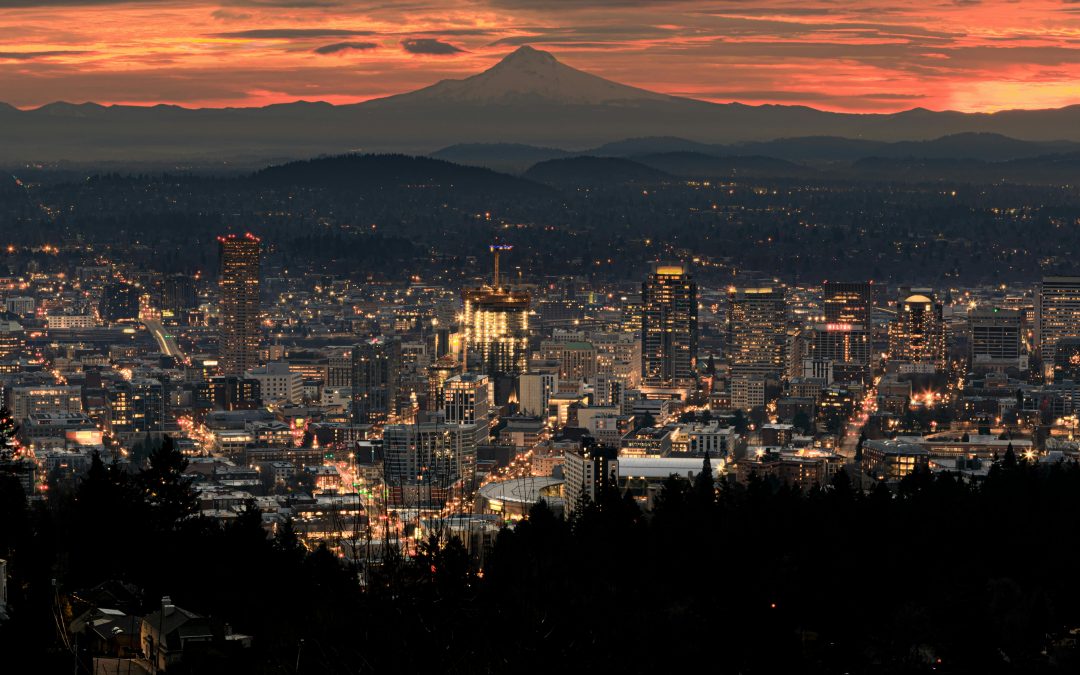
Downtown vacancy tells only half the story. The real opportunity lies in the neighborhoods, where retail is built to serve people, not just foot traffic counts.
Walk through downtown Portland on a Tuesday afternoon, and you’ll notice something the numbers have been telling us for a while: the storefronts are too quiet. Not all of them, not everywhere, but enough to make the signal unmistakable. Two cities that were once paragons of urban livability are at an inflection point, and how developers, investors, and city leaders respond will define the character of these neighborhoods for the next generation.
The data is stark. Downtown Portland’s retail vacancy reached 32% in Q4 2024, according to CoStar, up from 12.4% in Q4 2019. That’s nearly one in three storefronts sitting empty in the city’s core. Seattle’s retail market, meanwhile, saw vacancy rise to 4.0% metro-wide by year-end 2025, surpassing its 10-year historical average. Downtown office vacancy approached 35% in some submarkets, according to Cushman & Wakefield. When offices empty, the retail ecosystems built around them hollow out too.
Portland
- Downtown retail vacancy32%
- Pre-pandemic (Q4 2019)12.4%
- Metro-wide retail vacancy4.9%
- Retail rent (2024)$32.27/SF
Seattle
- Metro retail vacancy (2025)4.0%
- 10-year historical avg.3.8%
- Downtown office vacancy~35%
- Downtown visitors recovering94% of pre-COVID
But here’s what I believe the headline vacancy numbers miss: the problem isn’t retail itself. It’s the type of retail that both cities built their downtown models around, namely national chains dependent on office workers, tourists, and transient foot traffic. That model is broken. The replacement isn’t a different version of the same thing. It’s retail rooted in community.
The Neighborhood Retail Divide
Step outside the downtown cores, and a very different picture emerges. Across 47.6 million square feet of inventory, Portland’s metro-wide retail vacancy rate sits at just 4.9%, with neighborhood and community center retail outperforming in submarket after submarket. Seattle’s suburban submarkets, including Thurston, Snohomish, and Pierce Counties, are posting vacancy rates of just 3.3%, while small-box neighborhood retail continues to absorb space vacated by large-format national tenants.
This divergence is not an accident. Neighborhood retail serves a fundamentally different function than downtown destination retail. It serves residents, not commuters. It builds recurring relationships, not one-time transactions. It creates what urban planners call “third places,” spaces that are neither home nor work, where community identity is formed. Coffee shops where regulars know each other by name. Independent grocers that carry products for the specific populations they serve. Fitness studios, bookstores, and community kitchens. The kind of retail that makes a neighborhood feel like a neighborhood.
“Portland and Seattle don’t have a retail problem. They have a mismatch between the retail they built and the communities that need to be served.”
What Community Retail Actually Does
The evidence that community-anchored retail is a revitalization tool is no longer theoretical. In downtown Portland, a 28% year-over-year increase in foot traffic in the Old Town entertainment district in 2024 was driven not by office recovery but by activations, food halls, local cultural events, and community programming. The Flock food hall at Block 216, anchored by local and culturally diverse food operators, became a catalyst for the broader block’s recovery. Portland’s Director Park saw a 30% year-over-year increase in visitors in 2024 after programming that brought the community back to the space.
In Seattle, the Plaza Roberto Maestas development on Beacon Hill demonstrated what genuine community retail looks like in practice: two mixed-use buildings with housing, retail, and community space organized around a central public plaza, designed in direct response to neighborhood input and reflecting the cultural identity of the residents it serves. The result wasn’t just a leased-up building; it was a neighborhood anchor that hadn’t existed before.
These aren’t outliers. They’re a blueprint. In Portland, the city’s own revitalization analysis has been explicit: “revitalizing Portland’s communities requires street-level storefronts that are welcoming public spaces, restaurants, cafes, grocery stores, and shops that are inviting and safe for everyone.”
The Investment Thesis Is Real
From a development perspective, community-focused retail in both cities is a compelling opportunity precisely because so little purpose-built community retail has been delivered. Portland’s retail rents have declined 13% in real terms since 2019, bringing entry costs to levels that make community-serving operators, who could never afford peak-cycle rents, genuinely viable tenants. Seattle’s small-box retail continues to perform, while large-format space sits vacant, confirming that right-sized, neighborhood-oriented product is what the market is absorbing.
At LRE & Co, we believe the next generation of mixed-use development in both cities should treat retail not as an afterthought on the ground floor of a residential tower, but as a deliberate community investment. That means curating tenants who serve the existing neighborhood, designing spaces that invite lingering rather than throughput, and building programs, markets, events, and shared spaces that make retail a reason to be somewhere rather than simply a convenience while you’re passing through.
Portland and Seattle are cities that have long understood identity. The retail environments we build next should reflect that, not as an amenity but as an anchor.