
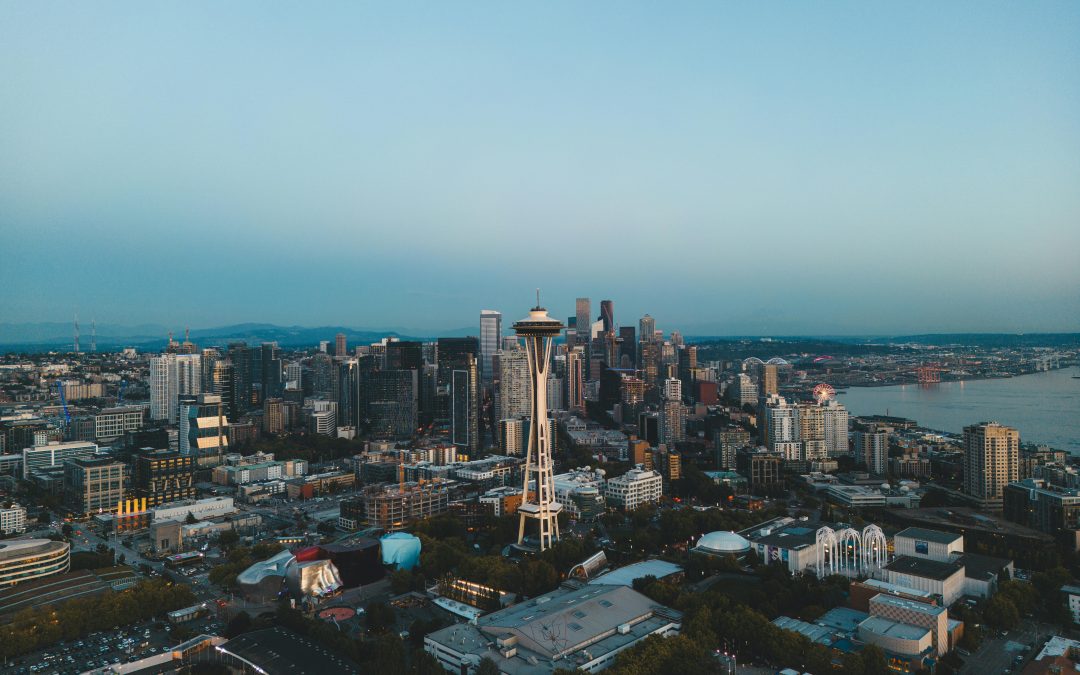
How Amazon, Microsoft, and a generation of startups rewrote the rules of urban development, and what it means for developers everywhere.
Seattle didn’t become a tech capital by accident. What was once defined by Boeing’s manufacturing might quietly transformed into one of North America’s most dynamic innovation corridors, and the commercial real estate landscape mirrored every step of that evolution. For developers, brokers, and investors paying attention, Seattle offers something rare: a live case study in how technology companies reshape cities from the ground up.
The Amazon Effect: Urban Over Suburban
The single most consequential real estate decision in Seattle’s modern history wasn’t made by a city planner. It was made by Amazon. When the company chose to build its headquarters in the Denny Triangle rather than retreat to a suburban campus, it signaled a generational shift in how tech giants decide where to plant their flag.
Amazon’s approach wasn’t simply to lease a tower. They engineered a living urban campus, woven into the street grid with public plazas, ground-floor retail, and direct transit access. The famous Spheres became civic architecture as much as a corporate amenity. Talent who wanted city life could have it, and the company benefited from the creative density that urban proximity creates.
The ripple effects were immediate and long-lasting. Real estate values climbed. Retail demand shifted. New residential density followed the jobs. For developers who had positioned themselves in adjacent corridors, returns were extraordinary. For those who hadn’t, it was a lesson learned too late.
Neighborhoods Transformed
Two districts tell Seattle’s transformation story most vividly.
South Lake Union: Industrial to mixed-use
Once a quiet warehousing district, it is now a walkable neighborhood of offices, residences, restaurants, and biotech labs, anchored by Amazon and life sciences investment.
Bellevue Downtown: Suburban to urban alternative
Microsoft’s eastside expansion gave Bellevue the gravitas to become a genuine urban core, complete with luxury retail, high-rise residential, and Class-A office towers.
Neither transformation was inevitable. Both required developers willing to bet on tech-driven demand before the proof points were clear. That willingness to read directional signals and act ahead of consensus is precisely what separated the winners from the observers in Seattle’s commercial real estate market.
What Tech Companies Actually Want
Understanding the occupier is the prerequisite for serving them well. Tech companies have distinct real estate priorities that differ meaningfully from those of traditional corporate tenants, and developers who internalize these requirements gain a lasting competitive edge.
- Transit access & walkability
Tech talent overwhelmingly prefers locations where they don’t need a car. Proximity to rail, ferry, and bike infrastructure is non-negotiable for premium leasing.
- Flexible, collaboration-first floorplates
Open plans, breakout zones, and infrastructure that accommodate rapid headcount swings. Long-term inflexibility kills deals.
- Sustainability credentials
LEED Platinum, net-zero targets, and embodied carbon reporting have moved from nice-to-have to lease-table requirements for top-tier tech occupiers.
- Amenity-rich surroundings
Ground-floor food, fitness, childcare, and retail. The neighborhood itself becomes part of the recruitment pitch, and developers who invest in placemaking are rewarded.
Post-Pandemic: Space Worth Commuting For
Remote work introduced genuine complexity into the demand for tech real estate. Vacancy rates in some Seattle submarkets climbed. Lease terms shortened. Sublease space flooded certain corridors. And yet, the story didn’t end there.
What emerged from the pandemic wasn’t the death of the tech office. It was its evolution. Companies began asking a harder question: why would someone commute? The answer forced a reexamination of what offices actually do. The best ones have become places for culture, serendipitous collaboration, and experiences that simply cannot be replicated over a video call. Developers building for this moment are designing spaces that feel more like hospitality than commercial real estate, because that’s what justifies the commute.
The office is no longer competing with a cubicle farm. It’s competing with a well-equipped home setup and a zero commute. Winning that competition requires a fundamentally different product.
The Opportunity in Secondary Markets
Not every developer can compete for Amazon’s next lease in a primary gateway city, nor should they try. Seattle’s rise has sparked a second wave of opportunity in markets that were once entirely off the tech radar.
Spokane, WA: Lower cost base attracting satellite offices and regional startup clusters
Boise, ID: Fast-growing tech talent pool with strong quality-of-life fundamentals
Eugene, OR: University proximity driving R&D-adjacent real estate demand
These markets share a common profile: lower occupancy costs, improving talent pipelines, and a generation of founders and operators who no longer view a San Francisco or Seattle ZIP code as a prerequisite for building something serious. For developers who can read those signals early and deliver a product aligned with tech-sector expectations, the risk-adjusted opportunity can be compelling.
The Bottom Line for Developers
Seattle’s evolution from Boeing town to tech capital isn’t just an interesting urban story — it’s a replicable framework. The developers who won big understood their occupiers, positioned themselves ahead of demand, and built a product that earned its place in the talent equation. The next Seattle is out there. The question is whether you’re watching the right signals.